-IreneSalter.png)
Me and Power

For me—and for many servant leaders I know—the very idea of power can feel loaded, even dirty. We skirt around its edges without directly confronting it. As soon as we have power, we give it away.
So let’s have an open, honest conversation about it.
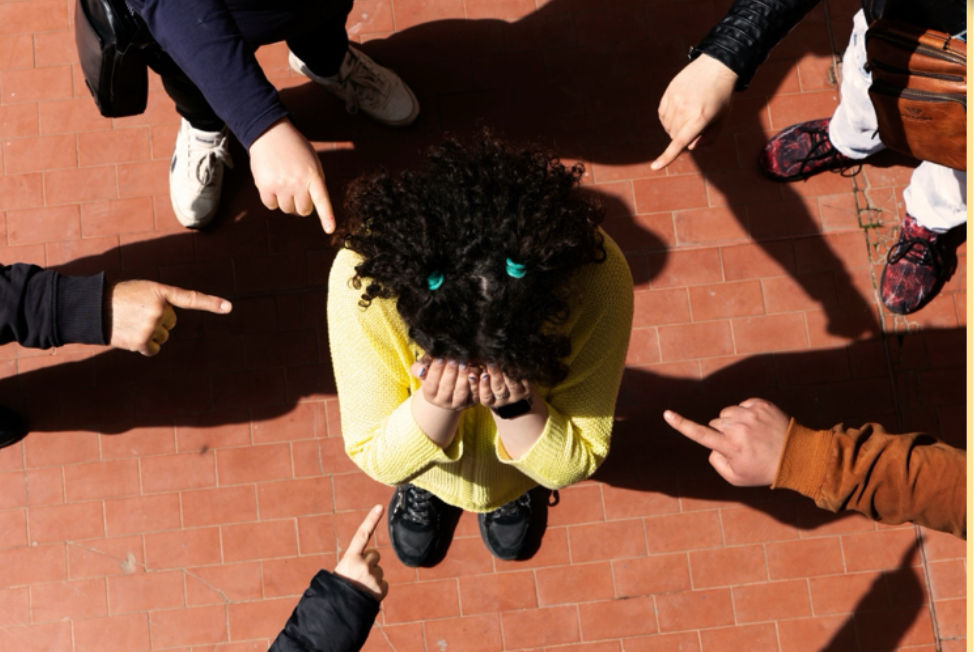
STORY: Welcome to Part 2 of musings about power! Perhaps you’ve already read Part 1 which discusses external abusive power like what you see in a toxic work environment. In contrast, this post is about internal abusive power… my own.
READ MORE: More resources on the topic of power
BOOK STUFF: Join us in reading Breath The New Science of a Lost Art by James Nestor in June and July, with zoom book club calls July 2 & July 30 at 4pm PST
GOING FURTHER: Organizational culture transformation is the most comprehensive and complex engagement I offer. When leadership, culture, systems, and relationships all require sustained attention simultaneously, this is what I do. Reach out if this is something your organization is needing.
STORY: Me and power
Four months ago I had a moment where 2 lines of text from someone in power hit me BAM and I went tumbling over the edge. At first I brooded with incredulity. Then I simmered with frustration and resentment. Until I finally flipped out entirely. I'M SO ANGRY! HURT! ENRAGED!
This wasn't just about the words on the screen. This was a lifelong pattern of feeling silenced and shut down by those more powerful than I.
My amygdala was trying to fight a 40-year old war in 2 lines of text.
To fully understand what was happening to me, you have to go back 40 years to grade school. This thing with me and power is personal. I was one of four non-white kids in a 1000-kid school in Dallas, Texas. My best friend — my only friend — was the only other Asian kid. I stayed small to survive in hallways full of permed-up cheerleaders and padded up football players.
And at home, the message was just as clear. Good Chinese daughters are supposed to be meek, obedient, helpful, hard-working, and uncomplaining."The tallest poppy gets cut," I was told.
Couple that backdrop with being the victim of middle school bullying and college sexual assault, and the end result is a nervous system that id incredibly sensitive to people wielding power over me. I got incredibly good at being the unobtrusive good girl and deferring to all those in power. I got good at letting myself be silenced. At staying small. At rejecting myself before I get rejected.
But at the same time I found myself as the one with power: Board Member, Department Chair, Superintendent… I didn’t like it.
Privately, I thought of power as the antagonist from Back to the Future, Biff Tannen. An abusive, belligerent, ostentatious bully. In other words, power was everything I strove not to be.
I could study power in others (including conducting honors thesis research on stress hormones in social dominance hierarchies). I could read cool research reviews about how the ventromedial prefrontal cortex of the brain helps evaluate social rank, authority, and social relationships and how the amygdala influences how we react to that assessment. But could I deftly navigate power dynamics in the real world or worse yet, talk about it?
Not so much.
Power Over
Fast forward to a coach training retreat with the Conscious Leadership Group in April of this year. They were throwing a “persona party”, and I had to pick a persona to get to know better. I walked up to one of the master coaches and suggested, “What if I go as a dark jedi? You know, like what might happen to Ruth Bader Ginsburg if she gave into anger and turned to the dark side.”
He turned to me and said, “No Irene. Go as Biff.”
My immediate reaction: Oh hell no! Eww. Yuck. Disgust. But ultimately, I agreed to try.
I dressed up with a tin foil crown, a plastic bat for a scepter, and a towel as a cape. I wrote "Emperor Biff” on my nametag. But when I tried to embody Biff, I was completely impotent. I stood on a chair yelling at people, demanding, commanding. I told people that I owned them and they had to do what I said, but absolutely nobody paid any attention to me.
Well that sucked I thought. I guess I just don’t have a Biff in me. Good thing too!
Because I really really didn’t want to be the kind of toxic leader that Biff represented to me. He holds power over others.
I learned about “Power Over” from Brené Brown. People operating from power over think that there’s not enough power to go around and that it’s far more important to be right than to get it right. Using power over shuts people down. It relies on control, fear, and dominance. Not me. That’s the destructive leader from the toxic triangle that I discussed in Part 1. Never me.
In contrast, “Power With, Power To, and Power Within” is a different option that emerges from connection, agency, empathy, and self-awareness. From this perspective, power is infinite and getting it right is more important than being right. Using Power With/To/Within builds others up. Sounds great! Sign me up.
Later in the retreat, we did a breathwork exercise and I had a metaphysical experience where my body lit up with power as if I’d plugged myself into a live wire, but a deeply good one. Electric tingles through every nerve. There was joy, pleasure, and aliveness, but the best word to describe it was radiance. I felt radiant.
And in a super secret voice that the master coaches couldn’t hear I whispered, Hah! See, I’m radiant as a Power With/To/Within kind of leader. I just don’t have a Power Over bone in me.
Oh, how wrong I was.
Biff in Coach's Clothing
I came home and merged back into my work and life and community service. But the retreat experience simmered quietly in the background of my mind, and I began seeing Biff in the real everyday people I was interacting with. Person X has a fragile ego like Biff. Person Y wants to be worshipped on a pedestal like Biff. Person Z is entitled and sees themself as better than others like Biff.
I kept meeting Biff everywhere I went. Not in toxic leaders necessarily, but in friends, community members I respected, my family.
Slowly, over weeks, Biff became less of a caricature and more of a real person. And then… I became aware of a really uncomfortable thought… oh shit! I see Biff in me.

fragile ego
desire to be worshipped on a pedestal
entitlement
seeing self as better than
thinking I’m right
scarcity mindset
needing constant validation and admiration
obsession with status and popularity
envy
hubris
giving/withholding love and connection as a way to control others
do it my way because I know best
dehumanization and othering (see this blog from 2 years ago)
Pause for a moment and read that list again. I sure did.
Because what I hadn't seen until now is that I exhibit each and every one of Biff’s traits, but I deny that truth to myself and shove it down. I would argue that every human feels each and every one of these items now and then. We wouldn’t be human otherwise.
I’m a person who needs to be adored — but sometimes can't claim the space in the room. I’ve built my life around getting attention, appreciation, and accolades — but keep pretending like I don’t care about those things. I have a strong advice monster who loves to be right and tell others what to do, how to think, what to believe, what's right or wrong — all the while claiming that I empower others.
That's not the absence of Biff. That's Biff in a coach's clothing.
For over a year I’ve been teaching clients about the Power Paradox — Dacher Keltner's conclusion that the very qualities that help people rise to leadership are the first to erode once they're in positions of power. And here I was living the power paradox in my very own life but couldn’t even see it.
Once I found the Biff in me, I kept catching myself at it. An email arrives and SNAP I’m so desperate for validation and approval that I small myself back to that good, meek Chinese daughter. Or I’m chosen to be coached in a circle of peers and WHAM as much as I want to claim the center of attention, I try to offer the spot to others. Or I’m chatting with a friend about troubles at work and BOOM my advice monster comes out wanting to be right.
The good news is I’m onto myself. Whereas a few months ago those 2 lines of text had me enraged for days and days, responding with barely concealed rage to the message and lashing out at my poor husband who did absolutely nothing wrong (sorry pal), now, because I’m catching myself, I can interrupt my Biff patterns before I act (most of the time, not always).
Power Source
This is scary work. It’s scary to write it down. It’s even scarier to share it.
Even as I design an elevated business plan for Inquiring Minds (see below for a new offering!), I have a deep deep fear inside me about stepping into my full radiant power. I might outshine others. I might hurt people with the heat of it. I might overwhelm myself. And now that I see all the characteristics of Biff inside of me, I’m scared that I might become Biff and use power over.
But that’s the paradoxical thing about power. In and of itself, power isn’t good or bad. Power determines who decides things, gets things, and does things in the world. It determines who sets the agenda. In a social species, power dynamics are inevitable. The question isn’t whether power is bad, but whether power is being used over or if it’s being used with/to/within.
Both possibilities are inside each of us. It’s our choice how to land.
When I’m afraid, I’m much more likely to fall into power over. When I’m grounded, I’m much more capable of using power with/to/within.
They key, I’m realizing, is sourcing power from the wholeness within. It's the same enoughness that a baby arrives with. The natural human goodness that doesn't need to be earned, performed, or proven, only rediscovered. It’s that electric power source I plugged into.
Nature is a great place to practice. The power of the ocean. The power of the wind. The power of the sun.
For instance, yesterday I sat under the mulberry tree in my backyard, walked along the roots barefoot, watched a mama robin in her nest, ate mulberries warm off the branch, and sketched. I thought about roots.
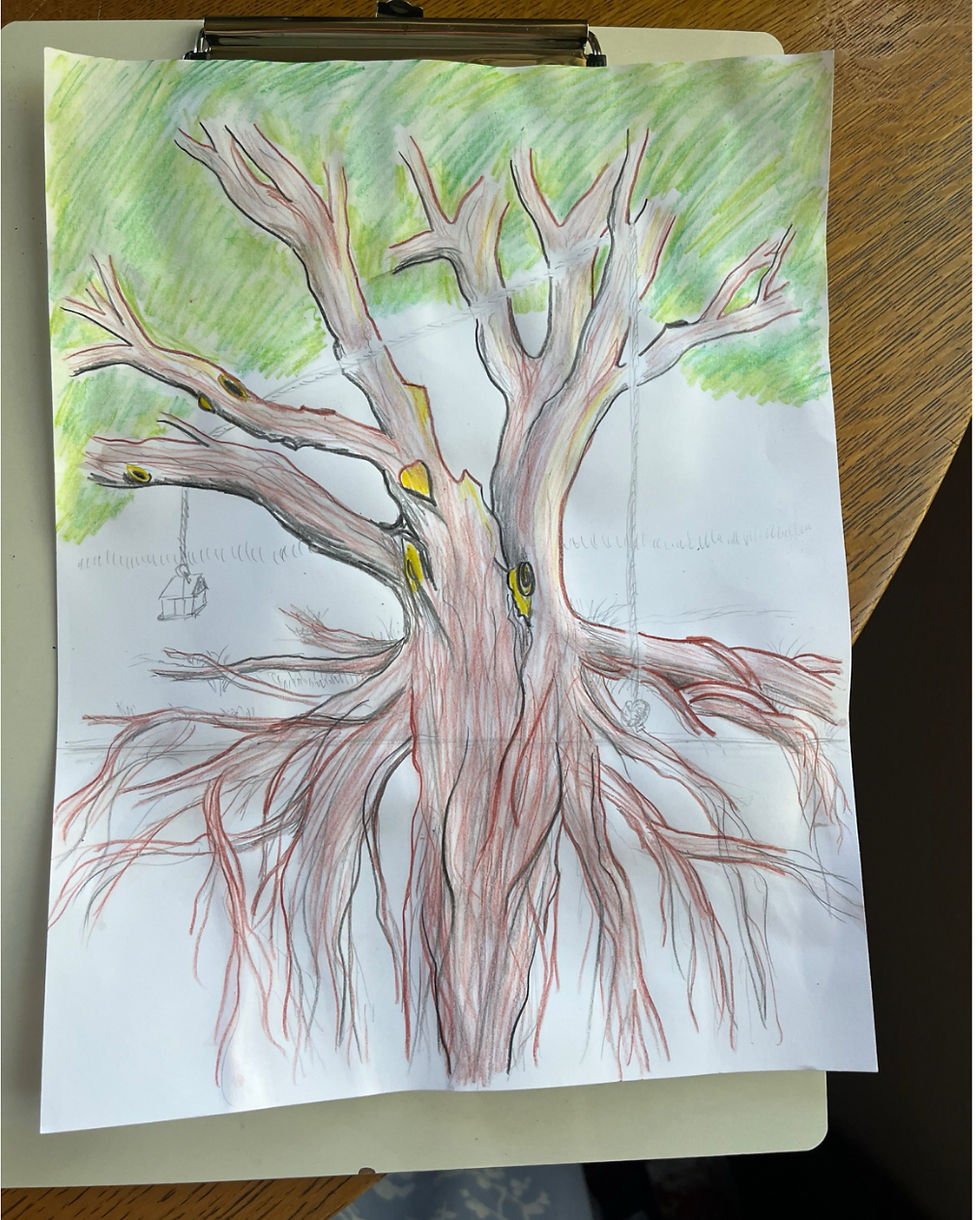
My mulberry tree has two very different kinds of roots. The surface ones spread wide across the lawn, shallow and opportunistic, sipping from sprinklers and rain. I can see these roots. I know them well. They're how I reach out to others for the approval and belonging I crave when I need to feel okay. The surface roots are the parts of me that are like Biff.
But there's also a taproot. Invisible. Going down past all of that. Past the lawn, past the sprinkler system, past anything I can see or control. All the way to the water table.
Neuroscience and developmental psychology both point to something similar in us. So much of what we reach for on the surface — approval, belonging, control, security — we learned from a young age to reach for as a survival strategy. Layer by layer, experience by experience, our nervous systems adapted to get those needs met from the outside. And over time, we can forget that underneath all of that neural patterning, there's something that was always already there.
Another way I practice sourcing power from within is through breathwork. I’m practicing that daily now. (Psst… book club is reading Breath by James Nestor and I’d love for you to join me!) Because of the daily practice, radiant power is more recognizable when it appears, and I’m beginning to be able to call it when I need it. When I'm in my zone of genius — coaching, creating, writing — I literally feel those same bodily sensations. Tingly and electric. Radiant in my arms and face and pelvis. It's so damn cool.
Just Associates says that power is “nuanced. It impacts us in obvious ways – discrimination, exclusion, repression – but also in invisible ways – the ideas and beliefs we internalize.” The go on to say that power is “at work inside us. We are often unaware of the norms, values, and conditioned behaviors that we internalize from birth and through the narratives and misinformation promoted by powerful interests.”
Well, my relationship to power was internalized at a very young age, just as it is with most people. But I’m onto myself. I can now see my Biff-like patterns and rewire my nervous system in new ways. I am learning how to form a new relationship with power, one that connects me via a taproot to the wholeness within.
This power work in me isn't done, but it has absolutely begun.
READ MORE: Resources on power
If you haven’t already read Part 1 of this blog I highly recommend it as it shares the toxic triangle that perpetuates abusive power situations.
Just Associates fights “to change the beliefs and structures that drive economic inequality, environmental destruction, and gender-based as well as political violence.” Their site is full of amazing resources for those of us who wish to “resist and challenge coercive power over by building and mobilizing transformative power.”
Definitely download Brené Brown’s lovely handout contrasting power over vs power with/to/within.
I am currently practicing breathwork through the Breath Vault with George Ramsay. I can’t recommend him highly enough.
BOOK STUFF:
If you'd like to explore breathwork and power with me, join us as we read Breath The New Science of a Lost Art by James Nestor in June and July.
The choice feels especially timely because I've been experimenting with breathwork myself. After months of seeing only modest results in my meditation EEG data, I switched from guided meditation to intentional breathwork and saw a dramatic increase in my Muse "calm" score—from 28% to 75%.
Breathing is fascinating because it sits at the intersection of body and mind. Most bodily processes happen outside our conscious control, but breathing is one function we can influence directly, giving us a unique pathway into the nervous system.
I'm still early in this experiment, but it's certainly captured my curiosity.
And as an additional endorsement, my graphics and web designer, Robin Canfield, told me: "James Nestor opened up a whole new world for me."
GOING FURTHER: New offer! Organizational culture transformation
I’ve already been doing this work for several organizations, but never named it and consolidated it under a single work. Organizational culture transformation is the most comprehensive and complex engagement I offer. When leadership, culture, systems, and relationships all require sustained attention simultaneously, this is what I do.
For example, I supported a leaderless group mired in drama and hurt feelings who emerged a year later with a self-designed plan for leading together, a collaborative spirit, and restored relationships. Right now I’m helping a school system move from traditional discipline and behavior management to restorative practices grounded in high accountability and high support.
If this is what you need, plan on a minimum one year of hard work together. It begins with a complete organizational systems assessment, followed by an in-person goal-setting and strategy half-day, then a custom combination of 1:1 coaching, team coaching, workshops, site visits, and board meeting attendance as the work requires.
Reach out if you’re interested.


Comments